How to Pray Istikhara: A Complete Guide to Prayer and Dua
Some decisions are easy to make. Others leave us uncertain, even after careful thought and consultation. You may be considering marriage, accepting a new job, starting a business or moving to another country.
Despite your efforts to make the right decision, you cannot always know what lies ahead.
The Prophet Muhammad ﷺ taught us to turn to Allah in such moments through Salat al-Istikhara, a voluntary prayer through which a Muslim seeks Allah's guidance and asks Him to choose what is best.
But how do you pray Istikhara correctly? What should you say? Do you need to see a dream afterwards, and how do you know whether to proceed with your decision?
This guide explains the purpose, method and supplication of Istikhara, drawing on the authentic Sunnah and recognised Sunni scholarship.
1. What Is Istikhara in Islam?
The Arabic word Istikhara (الاستخارة) means seeking what is best. In Islamic practice, it refers to asking Allah to choose what is beneficial when considering a particular matter.
Salat al-Istikhara consists of two voluntary units of prayer, known as rak'ahs, together with a specific supplication taught by the Messenger of Allah ﷺ.
Jabir ibn Abdullah, may Allah be pleased with him and his father, reported:
كَانَ رَسُولُ اللَّهِ ﷺ يُعَلِّمُنَا الاِسْتِخَارَةَ فِي الْأُمُورِ كَمَا يُعَلِّمُنَا السُّورَةَ مِنَ الْقُرْآنِ.
The Messenger of Allah ﷺ taught us Istikhara in our affairs just as he taught us a surah of the Quran.
Sahih al-Bukhari, 1166 — meaning of the hadith.
The care with which the Prophet ﷺ taught this prayer shows its importance in a Muslim's life. It is not reserved for extraordinary circumstances, but is a Sunnah that Muslims can practise whenever they face an appropriate decision.
2. The Importance and Virtues of Istikhara
A person may spend months planning something, only to discover that the opportunity was not as beneficial as it first appeared. Equally, something we initially dislike may eventually bring us unexpected goodness.
Our decisions are based on the knowledge available to us. Allah's knowledge encompasses everything, including the consequences we cannot foresee.
Allah says in the Quran:
وَعَسَىٰ أَنْ تَكْرَهُوا شَيْئًا وَهُوَ خَيْرٌ لَكُمْ ۖ وَعَسَىٰ أَنْ تُحِبُّوا شَيْئًا وَهُوَ شَرٌّ لَكُمْ ۗ وَاللَّهُ يَعْلَمُ وَأَنْتُمْ لَا تَعْلَمُونَ
You may dislike something although it is good for you, and you may love something although it is bad for you. Allah knows, while you do not know.
Surah Al-Baqarah, 2:216 — interpretation of part of the verse.
Although this verse occurs in the context of prescribed fighting, its wording reminds us of the limitations of human knowledge and the perfection of Allah's knowledge.
Istikhara puts this understanding into practice. Instead of simply asking Allah to give us what we want, we ask Him to give us what is truly good for us.
The spiritual benefits of Istikhara
- Following an authentic Sunnah of the Prophet ﷺ.
- Strengthening Tawakkul, or reliance upon Allah.
- Recognising the limitations of human knowledge and ability.
- Seeking Allah's assistance and blessings in our decisions.
- Asking Allah for protection from harmful outcomes.
- Seeking contentment with what Allah decrees.
No authentic narration establishes a specific numerical reward for performing Istikhara or guarantees that a person will receive the worldly outcome they initially desired.
3. When Should You Pray Istikhara?
Istikhara is recommended when a Muslim is considering a matter in which there is a legitimate choice. It may concern an important life decision or a relatively ordinary matter.
| Situation | Example |
|---|---|
| Marriage | Deciding whether to marry a particular person. |
| Employment | Accepting a job offer or changing careers. |
| Education | Choosing a university or programme of study. |
| Business | Entering a partnership or starting a permissible business. |
| Travel | Travelling at a particular time or relocating. |
| Housing | Purchasing or renting a particular property. |
| Family matters | Choosing between suitable arrangements for your family. |
Istikhara is not performed to decide whether an established religious obligation should be fulfilled or whether a prohibited action should be committed.
For example, a Muslim does not need to pray Istikhara to decide whether to perform the five daily prayers. Their obligation is already established.
However, Istikhara may be performed when choosing between permissible ways of fulfilling an obligation, such as suitable travel arrangements for Hajj, provided that the obligation itself is not neglected.
4. How to Pray Istikhara Step by Step
The method of Istikhara is simple. It follows the ordinary manner of performing two voluntary rak'ahs, together with the supplication taught by the Prophet ﷺ.
In the authentic hadith, the Prophet ﷺ said:
إِذَا هَمَّ أَحَدُكُمْ بِالأَمْرِ فَلْيَرْكَعْ رَكْعَتَيْنِ مِنْ غَيْرِ الْفَرِيضَةِ ثُمَّ لِيَقُلْ...
When one of you intends to undertake a matter, let him pray two rak'ahs other than the obligatory prayer, then let him say...
Sahih al-Bukhari, 1166.
Step 1: Perform Wudu
Make ablution and fulfil the usual conditions of Salah, including facing the Qiblah and covering the required parts of the body.
Step 2: Make your intention
Intend in your heart to perform Istikhara concerning the matter you are considering. There is no prescribed verbal formula for this intention.
Step 3: Pray two voluntary rak'ahs
In the first rak'ah, recite Surah Al-Fatihah followed by another portion of the Quran. Complete the bowing and prostrations as in an ordinary voluntary prayer.
Perform the second rak'ah in the same manner, recite the final Tashahhud and conclude the prayer with Taslim.
Step 4: Recite the Istikhara dua
After completing the prayer, recite the authentic Istikhara supplication. This is the method recommended by Shaykh Abdul Aziz Ibn Baz, who also recommended raising the hands while supplicating.
Other scholars permitted reciting the supplication before Taslim. This recognised difference of scholarly opinion is explained further below.
| Part of the prayer | What to do |
|---|---|
| Preparation | Perform Wudu and fulfil the conditions of Salah. |
| Intention | Intend Istikhara in your heart. |
| First rak'ah | Al-Fatihah followed by a portion of the Quran. |
| Second rak'ah | Al-Fatihah followed by a portion of the Quran. |
| Conclusion | Complete the prayer with Taslim. |
| Supplication | Recite the authentic Istikhara dua. |
Are there specific surahs for Istikhara?
Some jurists recommended reciting Surah Al-Kafirun in the first rak'ah and Surah Al-Ikhlas in the second.
However, no authentic Prophetic report establishes these two surahs specifically for Istikhara. You may recite whatever is easy for you from the Quran after Al-Fatihah.
Further reading: Shaykh Ibn Baz — Salat al-Istikhara.
5. The Authentic Istikhara Dua in Arabic
The following supplication was narrated by Jabir ibn Abdullah and is recorded in Sahih al-Bukhari.
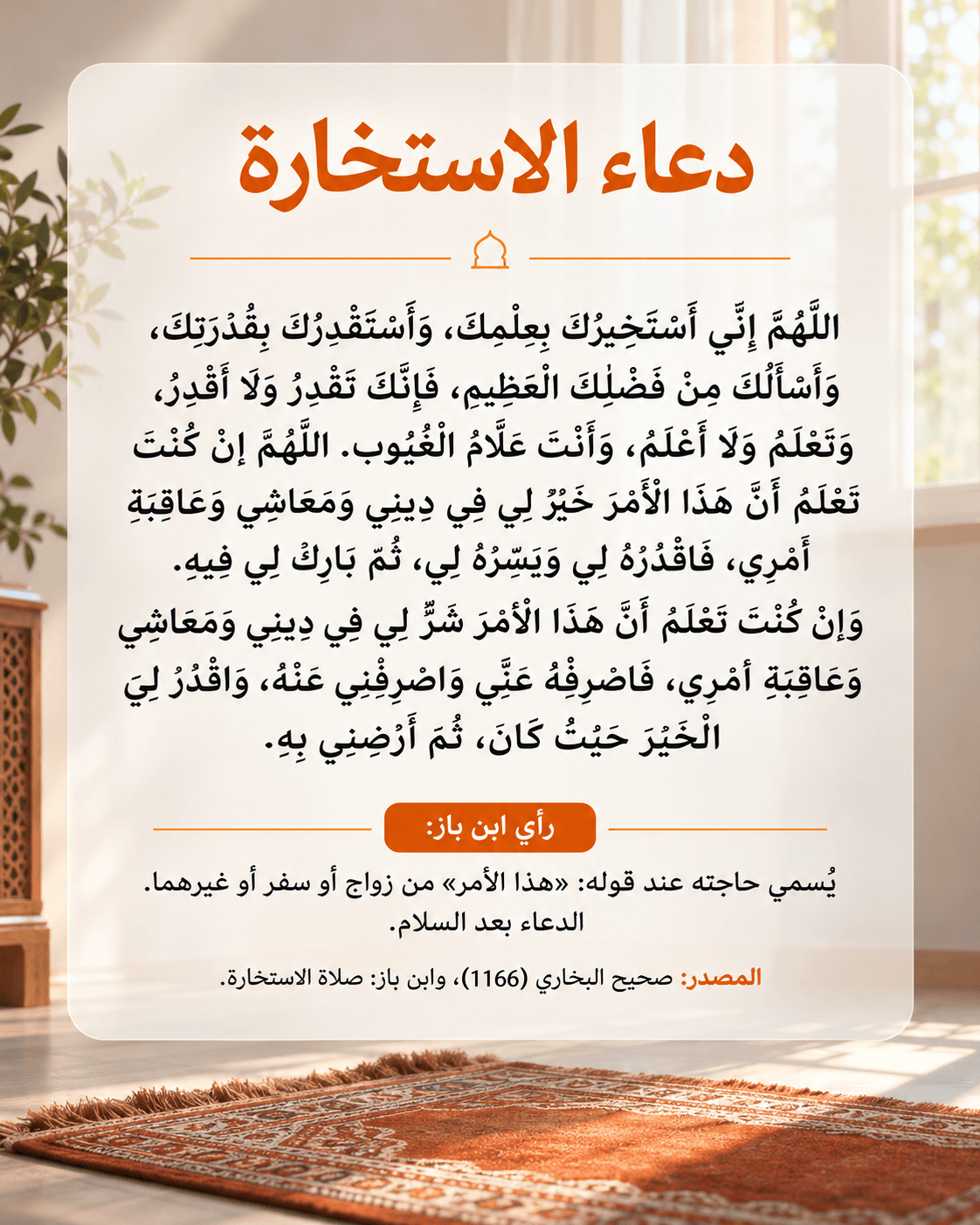
اللَّهُمَّ إِنِّي أَسْتَخِيرُكَ بِعِلْمِكَ، وَأَسْتَقْدِرُكَ بِقُدْرَتِكَ، وَأَسْأَلُكَ مِنْ فَضْلِكَ الْعَظِيمِ، فَإِنَّكَ تَقْدِرُ وَلَا أَقْدِرُ، وَتَعْلَمُ وَلَا أَعْلَمُ، وَأَنْتَ عَلَّامُ الْغُيُوبِ.
اللَّهُمَّ إِنْ كُنْتَ تَعْلَمُ أَنَّ هَذَا الْأَمْرَ خَيْرٌ لِي فِي دِينِي وَمَعَاشِي وَعَاقِبَةِ أَمْرِي، فَاقْدُرْهُ لِي وَيَسِّرْهُ لِي، ثُمَّ بَارِكْ لِي فِيهِ.
وَإِنْ كُنْتَ تَعْلَمُ أَنَّ هَذَا الْأَمْرَ شَرٌّ لِي فِي دِينِي وَمَعَاشِي وَعَاقِبَةِ أَمْرِي، فَاصْرِفْهُ عَنِّي وَاصْرِفْنِي عَنْهُ، وَاقْدُرْ لِيَ الْخَيْرَ حَيْثُ كَانَ، ثُمَّ أَرْضِنِي بِهِ.
Source: Sahih al-Bukhari, 1166. The narration also records an alternative wording, عَاجِلِ أَمْرِي وَآجِلِهِ, referring to the immediate and later consequences of one's affairs.
6. Istikhara Dua Transliteration
For readers who are still learning Arabic, the following transliteration may help with learning the supplication.
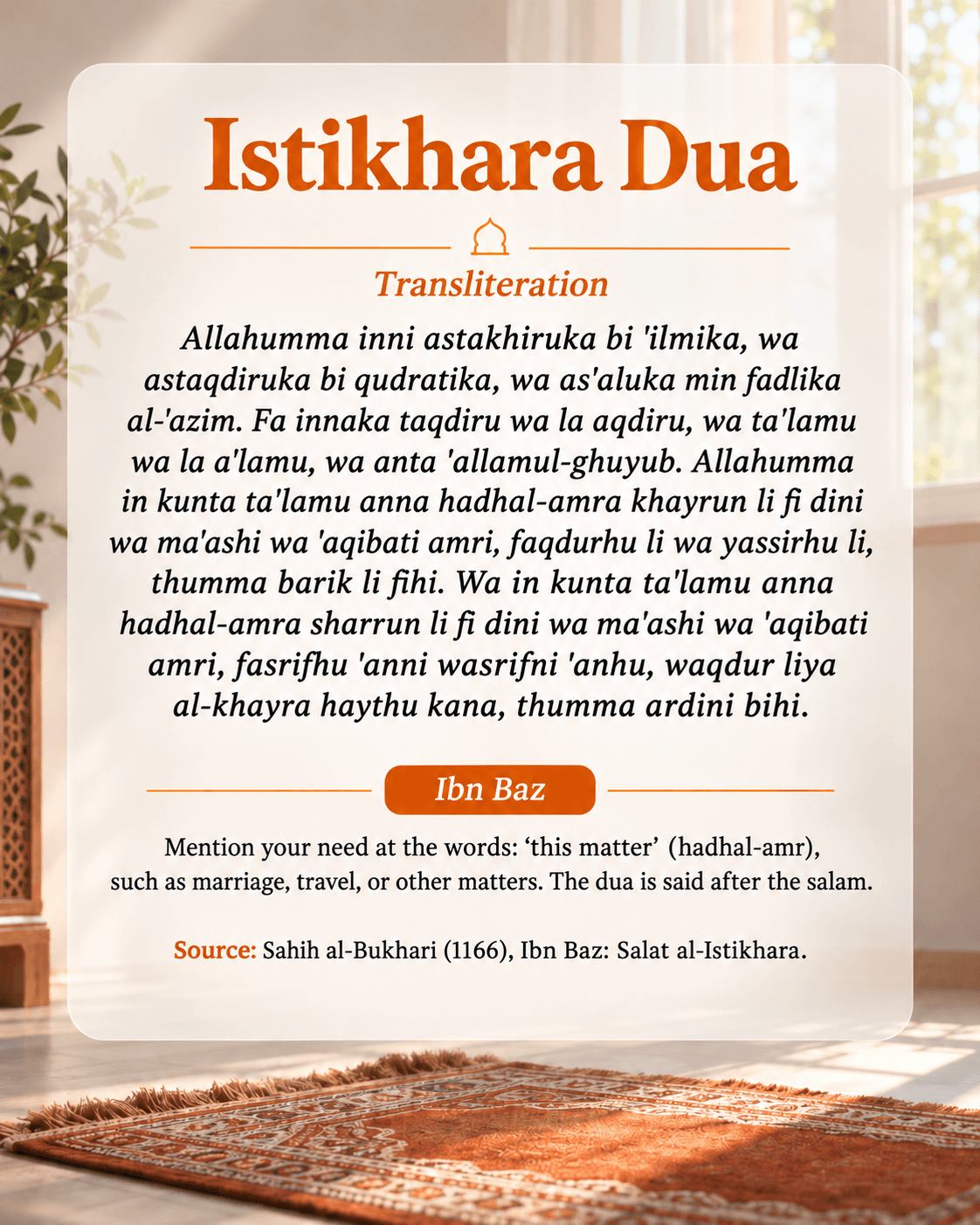
Allahumma inni astakhiruka bi 'ilmika, wa astaqdiruka bi qudratika, wa as'aluka min fadlika al-'azim. Fa innaka taqdiru wa la aqdiru, wa ta'lamu wa la a'lamu, wa anta 'allamul-ghuyub.
Allahumma in kunta ta'lamu anna hadhal-amra khayrun li fi dini wa ma'ashi wa 'aqibati amri, faqdurhu li wa yassirhu li, thumma barik li fihi.
Wa in kunta ta'lamu anna hadhal-amra sharrun li fi dini wa ma'ashi wa 'aqibati amri, fasrifhu 'anni wasrifni 'anhu, waqdur liya al-khayra haythu kana, thumma ardini bihi.
Transliteration is an approximate reading aid and cannot fully represent every Arabic sound. Learning the original pronunciation from a qualified teacher is recommended.
7. Istikhara Dua English Translation
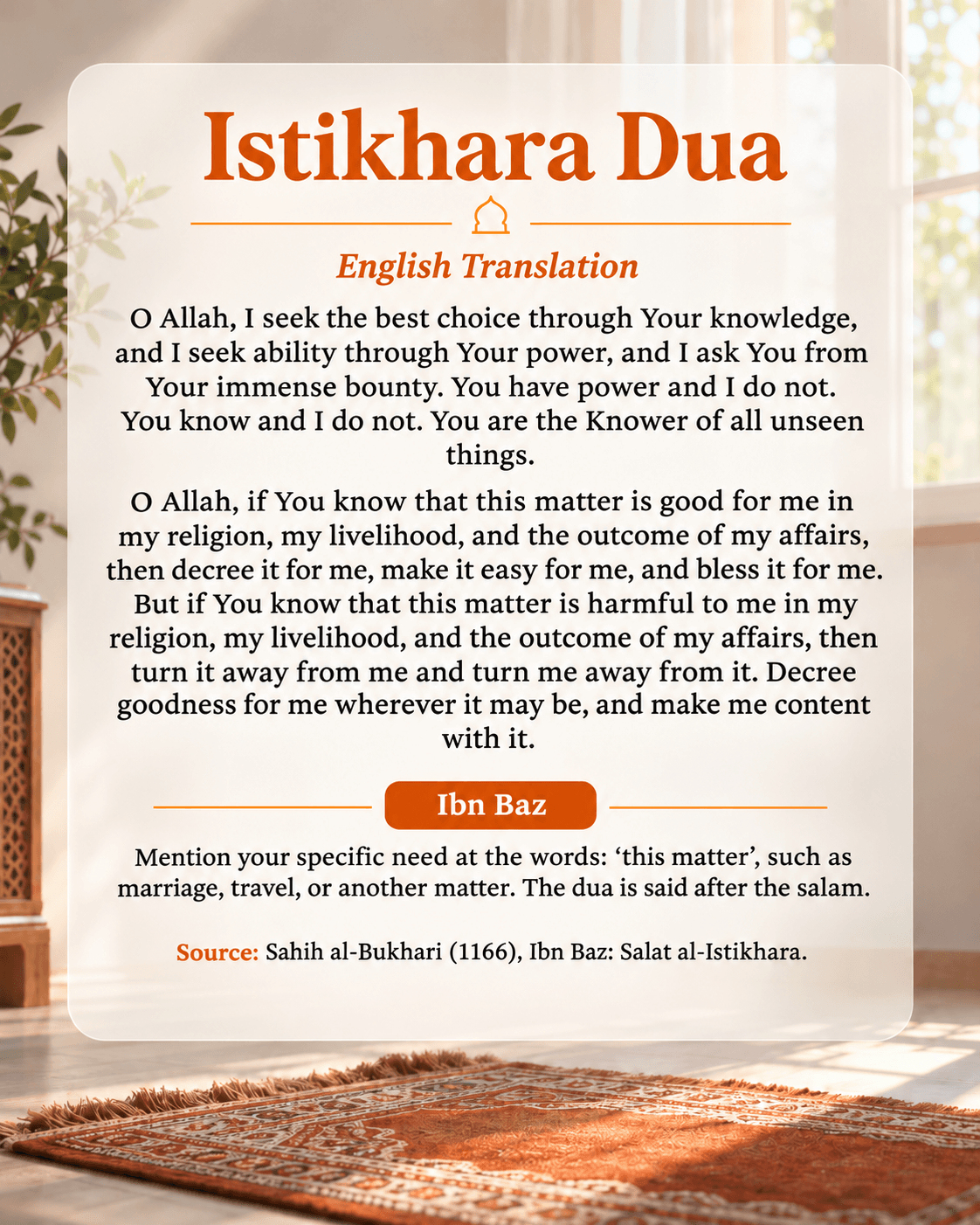
O Allah, I seek the best choice through Your knowledge, I seek ability through Your power, and I ask You from Your immense bounty. You have power and I do not; You know and I do not; and You are the Knower of all unseen things.
O Allah, if You know that this matter is good for me in my religion, my livelihood and the outcome of my affairs, then decree it for me, make it easy for me, and bless it for me.
If You know that this matter is harmful to me in my religion, my livelihood and the outcome of my affairs, then turn it away from me and turn me away from it. Decree what is good for me wherever it may be, and make me content with it.
An English rendering of the meaning of the supplication narrated in Sahih al-Bukhari, 1166.
8. When Should You Mention Your Specific Request?
One question frequently asked about Istikhara is whether a person must mention their specific need verbally during the supplication.
The authentic hadith of Jabir ibn Abdullah concludes with the words:
وَيُسَمِّي حَاجَتَهُ.
And he names his need.
Sahih al-Bukhari, 1166.
Shaykh Ibn Baz's explanation
Shaykh Abdul Aziz Ibn Baz explained that when the person reaches the words hadhal-amr (this matter), they should identify the specific matter being considered.
In his explanation of the supplication, he stated:
وَيُسَمِّيهِ بِعَيْنِهِ مِنْ زَوَاجٍ أَوْ سَفَرٍ أَوْ غَيْرِهِمَا.
He identifies the particular matter, whether it is marriage, travel or something else.
Shaykh Ibn Baz — Salat al-Istikhara, Majmu' Fatawa wa Maqalat, 11/421.
Examples of naming your specific matter
| Your decision | What you may mention |
|---|---|
| Marriage | My marriage to this particular person. |
| Buying a car | My purchase of this particular car. |
| Employment | My acceptance of this job offer. |
| Travel | My journey to this particular country. |
For example, if you are considering purchasing a car, you may identify your request as follows:
O Allah, if You know that this matter — purchasing this car — is good for me in my religion, my livelihood and the outcome of my affairs...
The additional words identifying the purchase are not part of the original Prophetic supplication. They simply identify the matter referred to in the dua.
Must the request be mentioned verbally?
In his commentary on Sahih al-Bukhari, the hadith scholar Ibn Hajar al-Asqalani discussed the instruction to name one's need.
He explained that the apparent wording suggests mentioning the matter verbally, while also acknowledging the possibility of simply keeping it in mind during the supplication.
Therefore, verbally identifying the matter follows the apparent wording of the hadith. However, the hadith does not explicitly establish verbal identification as a condition for the validity of Istikhara.
Reference: Ibn Hajar al-Asqalani, Fath al-Bari, commentary on Sahih al-Bukhari, hadith 1166.
The explanations accompanying the three images above reflect Shaykh Ibn Baz's position regarding naming the matter and making the supplication after Taslim. Other recognised scholarly opinions are discussed in this guide.
9. Understanding the Meaning of Istikhara Dua
Learning the words of the supplication is important, but understanding their meaning helps us appreciate what we are actually asking Allah for.
| Part of the supplication | Meaning and significance |
|---|---|
| أَسْتَخِيرُكَ بِعِلْمِكَ | Seeking the best choice through Allah's perfect knowledge. |
| وَأَسْتَقْدِرُكَ بِقُدْرَتِكَ | Seeking ability and assistance through Allah's power. |
| فَاقْدُرْهُ لِي وَيَسِّرْهُ لِي | Asking Allah to decree and facilitate what is beneficial. |
| ثُمَّ بَارِكْ لِي فِيهِ | Seeking blessings in the outcome. |
| فَاصْرِفْهُ عَنِّي وَاصْرِفْنِي عَنْهُ | Asking Allah to turn harm away from us and turn us away from it. |
| ثُمَّ أَرْضِنِي بِهِ | Seeking contentment with the goodness Allah decrees. |
Notice that we do not ask only for the opportunity itself. We ask Allah to bless it if it is good for us, protect us from it if it is harmful, and make us content with whatever goodness He decrees.
Obtaining something we want is not necessarily the same as obtaining something that is good for us.
10. What Is the Best Time to Pray Istikhara?
There is no particular hour of the day or night prescribed exclusively for Istikhara. It may generally be performed whenever voluntary prayer is permitted.
The last third of the night is a virtuous time for supplication in general, as established in authentic hadith. However, performing Istikhara at that time is not a requirement.
See Sahih al-Bukhari, 1145 and Sahih Muslim, 758a.
Times when voluntary prayer is restricted
As a general rule, voluntary prayer should be avoided during the following periods:
- After Fajr prayer until the sun has risen sufficiently.
- When the sun is at its highest point, shortly before Dhuhr.
- After Asr prayer until sunset.
Scholars differ concerning voluntary prayers performed for a specific reason during these periods. Some permit Istikhara when the decision is urgent and cannot be delayed.
When the matter can wait, performing Istikhara outside these periods avoids the scholarly disagreement.
11. What Should You Do After Praying Istikhara?
Many people perform Istikhara and then wait for an unusual event, a dream or a sudden feeling before making their decision.
The authentic hadith establishes no such requirement.
After Istikhara, continue considering your options, consulting trustworthy people and assessing the circumstances. Seeking Allah's guidance does not remove the responsibility to make a reasonable decision.
Allah says:
وَشَاوِرْهُمْ فِي الْأَمْرِ ۖ فَإِذَا عَزَمْتَ فَتَوَكَّلْ عَلَى اللَّهِ
Consult them concerning the matter. Then, when you have resolved to act, place your trust in Allah.
Surah Aal-Imran, 3:159 — interpretation of part of the verse.
Combining Istikhara with consultation
If you are considering marriage, learn about the prospective spouse's religion, character and circumstances.
If you are considering a business partnership, examine its financial and legal implications. If the matter concerns your health, seek qualified medical advice.
Taking appropriate practical steps is consistent with trusting Allah.
12. Do You Need to See a Dream After Istikhara?
No. Seeing a dream is not a condition of Istikhara.
There is no authentic evidence establishing that a person must perform Istikhara immediately before sleeping or see a particular colour in a dream.
A person may perform Istikhara without experiencing any dream or unusual event afterwards.
Does feeling comfortable mean the answer is yes?
Scholars have discussed the significance of a matter becoming easier or a person feeling more inclined towards it after Istikhara.
Such circumstances may be considered alongside other relevant information. However, a feeling is not revelation, and every difficulty should not automatically be interpreted as proof that Allah wants you to abandon a particular decision.
Proceed responsibly with the information available to you while continuing to rely upon Allah.
Further reading: Istikharah Signs.
13. How to Pray Istikhara for Marriage
Marriage is one of the most common reasons for performing Istikhara. However, there is no separate prayer or special supplication prescribed exclusively for marriage.
Follow the same method established in the authentic Sunnah:
- Consider the person's religious commitment, character and suitability.
- Consult trustworthy people with relevant knowledge.
- Perform two voluntary rak'ahs.
- Recite the authentic Istikhara supplication, identifying the proposed marriage as explained above.
- Continue assessing the matter and place your trust in Allah.
Do not disregard serious concerns simply because you experienced a pleasant dream. Equally, ordinary nervousness about marriage should not automatically be interpreted as an instruction to reject the proposal.
Istikhara complements a careful decision. It does not remove the need to make one.
14. Can You Repeat Istikhara More Than Once?
Yes. Scholars permit repeating Istikhara when a person remains uncertain about a matter.
However, no authentic hadith establishes that Istikhara must be performed three times, seven times or on seven consecutive nights.
The narration sometimes circulated about performing Istikhara exactly seven times is not authentic.
You may repeat the prayer when there is a genuine need, but there is no requirement to continue repeating it until you experience a particular dream or feeling.
15. Common Mistakes About Istikhara
| Common misconception | What you should know |
|---|---|
| You must see a dream afterwards. | No dream is required by the authentic Sunnah. |
| Istikhara is only for marriage. | It applies to many decisions involving a legitimate choice. |
| You must pray seven times. | No authentic fixed number is prescribed. |
| You must pray before sleeping. | No such condition is established. |
| Green means yes and red means no. | There is no authentic evidence for this interpretation. |
| Every obstacle is a negative sign. | Individual difficulties are not conclusive proof. |
| Istikhara replaces consultation. | Seeking advice and taking practical steps remain important. |
| A religious figure must perform it for you. | The Sunnah teaches the person considering the matter to perform Istikhara. |
| Naming the matter verbally is a condition of validity. | Verbal identification follows the apparent wording of the hadith, but its status as a mandatory condition is not explicitly established. |
Frequently Asked Questions About Istikhara
Is Istikhara obligatory?
No. Salat al-Istikhara is a recommended Sunnah rather than an obligatory prayer.
Should the Istikhara dua be recited before or after Salam?
Shaykh Ibn Baz recommended reciting the supplication after Taslim.
Shaykh al-Islam Ibn Taymiyyah considered both timings permissible and preferred supplication before Taslim. This is a recognised difference of scholarly opinion.
See Ibn Taymiyyah, Al-Fatawa al-Kubra, 2/265, and Ibn Baz's explanation of Salat al-Istikhara.
Can I read the Istikhara dua from my phone?
Yes. If you have not memorised the supplication, you may read it from your phone, a book or a written text after completing the prayer.
Can I make Istikhara dua in English?
If you do not know Arabic, you may supplicate in a language you understand after the prayer. Learning the original Arabic wording is encouraged so that you can follow the supplication taught by the Prophet ﷺ.
Can a woman make Istikhara during menstruation?
A menstruating woman does not perform the two rak'ahs of Salah. However, she may ask Allah for guidance by reciting the Istikhara supplication without performing the prayer.
Further reading: Istikharah During Menstruation.
Can I pray Istikhara after Isha?
Yes. Istikhara may be performed after Isha, and there is no requirement to wait until immediately before sleeping.
Can someone else pray Istikhara for me?
The method taught in the authentic hadith is for the person considering the decision to perform Istikhara. Other people may make general supplication for that person's guidance and wellbeing.
Can I pray Istikhara for more than one matter?
You may seek Allah's guidance concerning different matters. Performing Istikhara separately for each decision allows you to identify each matter more clearly.
What if I do not feel anything after Istikhara?
You are not required to experience a particular emotion, dream or unusual event. Continue considering the matter, seek appropriate advice, and proceed responsibly while trusting Allah.
Making Decisions With Trust in Allah
Istikhara teaches us something that is easy to forget when facing an important decision: we are responsible for making a sincere effort, but we do not possess complete knowledge of the future.
Sometimes the opportunity we hoped for becomes available. At other times, circumstances lead us in a different direction.
Rather than trying to uncover the unseen, we ask Allah for what is good, take the appropriate steps and seek contentment with His decree.
May Allah guide us towards what is beneficial, protect us from harm, bless our decisions and make us content with the goodness He decrees for us. Ameen.
And Allah knows best.
References and Further Reading
- Sahih al-Bukhari, Hadith 1166 — the principal narration of Salat al-Istikhara and its supplication.
- Sahih al-Bukhari, Hadith 6382 — another narration of the Istikhara supplication, with differences in wording.
- The Quran, Surah Al-Baqarah, 2:216.
- The Quran, Surah Aal-Imran, 3:159.
- Sahih al-Bukhari, 1145 — supplication during the last third of the night.
- Shaykh Abdul Aziz Ibn Baz — Salat al-Istikhara.
- Shaykh Ibn Baz — When Istikhara Is Prescribed.
- Ibn Hajar al-Asqalani, Fath al-Bari, commentary on Sahih al-Bukhari, hadith 1166.
- Ibn Taymiyyah, Al-Fatawa al-Kubra, 2/265.
- How to Pray Istikharah.
- Istikharah Prayer — Related Rulings.
- Istikharah Signs.
- Istikharah During Menstruation.
Learn Islam With Understanding
Deepen your understanding of the Quran, Arabic and Islamic Studies through personalised online lessons with qualified teachers at Firdaws Academy.
Book Your Free Trial Lesson